
The Ultimate Grand Himalayan Circuit
July 3, 2025
The Roof of the World: Why Every Motorcyclist Dreams of the Indian Himalayas
December 3, 2025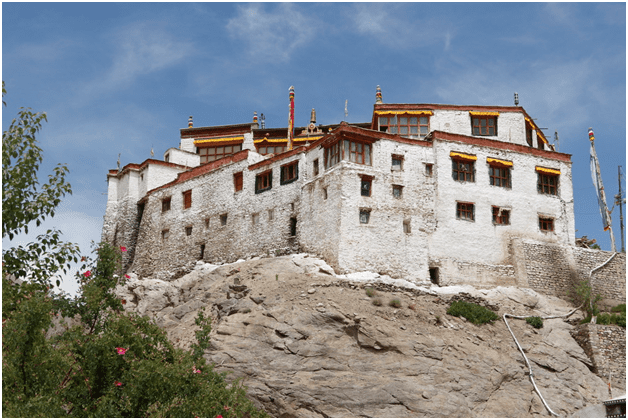
There are motorcycle rides that test your endurance. There are routes that reward you with scenery. And then, there is Zanskar—a journey that does both, while touching your soul in ways you’ll never forget.
The ride from Kargil to Darcha, cutting across the remote Zanskar Valley, is not just another Himalayan road trip. It’s a pilgrimage into one of the last untouched frontiers of the Indian Himalayas—where towering peaks, ancient monasteries, glaciers, wild rivers, and centuries-old villages come together in an unforgettable experience.
This is the story of riding through Zanskar—where every kilometer feels like a discovery.
Kargil – Where the Journey Begins
The odyssey starts in Kargil, a bustling town where Ladakhi and Kashmiri cultures meet. It is hard to imagine, standing in its crowded bazaar, that just a few hours away lies a world of silence and wilderness.
Riding out of Kargil, the road hugs the Suru River, flowing fast and cold from the glaciers of Zanskar. The first stretch lulls you with gentle curves, fertile fields, and apricot orchards glowing orange in the sun. It feels almost pastoral—until the mountains begin to rise.
The Giants of Suru Valley – Nun and Kun
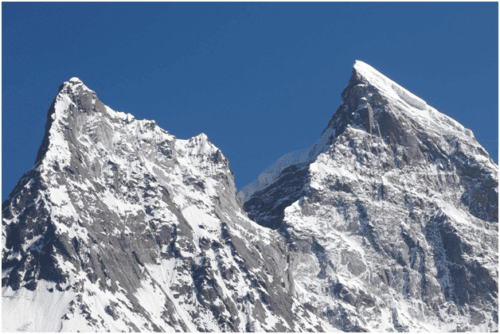
The further you ride into the Suru Valley, the mightier the scenery becomes. Suddenly, dominating the skyline, you see them: Nun (7,135m) and Kun (7,077m), twin peaks that stand as sentinels over the valley.
They are the highest peaks in the Indian Himalayas outside the Karakoram, and their sheer scale is humbling. Glaciers cascade down their slopes like frozen rivers, feeding the Suru and sustaining life in the villages below. On clear days, their snow-white summits shine like beacons, visible from dozens of kilometers away.
Riders often pause here, engines switched off, just to absorb the grandeur. The sound of the wind, the distant crack of ice shifting on the glaciers, the sight of sunlight breaking over Nun–Kun—it’s a memory etched forever.
The Ancient Villages of Suru
The Suru Valley is dotted with timeless villages—Panikhar, Parkachik, Tangole—where stone houses cluster around barley fields and willow groves. Life here has changed little in centuries. Villagers, wrapped in traditional woolens, tend to their flocks of sheep and yaks, while children wave enthusiastically at passing riders.
At Parkachik, the road skirts the Parkachik Glacier, an immense wall of ice tumbling almost down to the road itself. Massive seracs glisten under the sun, and the glacier seems alive—creaking and groaning as it inches forward. It’s one of the rawest sights of the journey.
This is where you start to feel Zanskar’s remoteness—each hamlet a self-contained world, where winter isolation can last up to eight months.
Rangdum – A Monastery at the Edge of the World
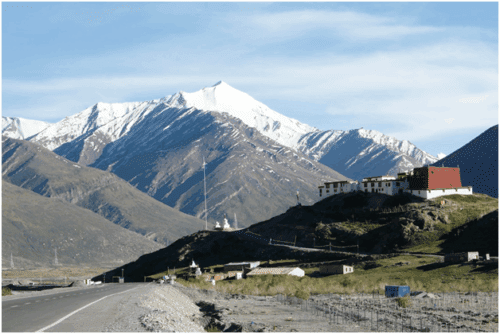
Hours later, the valley opens into a vast, windswept plateau. Here stands Rangdum Monastery, perched on a small hillock like a fortress of faith. Surrounded by meadows where wild horses graze and snow-capped peaks loom, Rangdum feels otherworldly.
The monastery, belonging to the Gelugpa order, houses monks who live in near-total isolation. Step inside and you’ll find flickering butter lamps illuminating ancient murals, the scent of incense mixing with the thin mountain air. Outside, prayer flags whip in the wind, carrying mantras across the empty plains.
For riders, Rangdum is often a place to camp, the night sky above alive with millions of stars. Few experiences match sitting by a campfire here, with your bike resting nearby, and realizing how far away you are from the modern world.
Pensi La – Gateway to Zanskar
From Rangdum, the road climbs steeply towards Pensi La (4,400m), the high pass that opens the gate into Zanskar. The ascent is dramatic—switchbacks curling higher and higher, the wind picking up, snow often lingering on the edges even in summer.
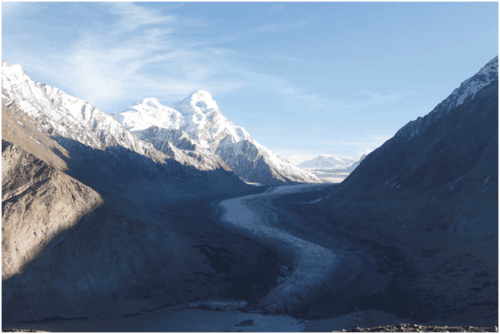
At the crest, the view explodes: the magnificent Drang-Drung Glacier, one of the largest in Ladakh. Stretching for over 23 kilometers, it coils down the valley in a frozen river of ice, flanked by jagged, black peaks.
Standing there, gazing at this mighty glacier, you feel the raw power of nature. The silence is broken only by the flap of prayer flags and the rush of icy streams below. For many riders, this is the most unforgettable vista of the entire ride.
Padum – The Heart of Zanskar
Descending from Pensi La, the landscape shifts. The river valleys widen, and soon you roll into Padum, the administrative and cultural hub of Zanskar. It’s a sleepy town, yet it feels like a metropolis compared to the remote villages you’ve just passed.
Padum makes a perfect base to explore the treasures of Zanskar:
- Karsha Monastery – The largest in Zanskar, dramatically spilling down a hillside, home to hundreds of monks. At sunrise, the chants echoing across the valley are mesmerizing.
- Stongdey Monastery – Perched on a hilltop, its whitewashed walls overlook a sweeping panorama of the Zanskar Valley.
- Zangla Palace – A ruined fortress-palace of the old Zanskari kings, standing silently as a reminder of Zanskar’s royal past.
The people of Padum are warm and welcoming, quick to invite travelers for tea. Their faces, weathered by sun and wind, carry stories of centuries of survival in this harsh but beautiful land.
Phuktal Monastery – A Walk Back in Time
From Padum, many riders detour to Purne, and then trek to the legendary Phuktal Monastery. The walk itself is unforgettable—narrow trails hugging cliffs above the roaring Lungnak River, suspension bridges swaying underfoot, and tiny villages like Cha and Anmu tucked into the gorge.
And then, suddenly, you see it: Phuktal, clinging to the mouth of a massive cave high above the river. It looks like it has grown out of the mountain itself, a honeycomb of whitewashed cells, prayer halls, and meditation caves.
Inside, monks in saffron robes chant in dimly lit chambers, the air heavy with incense. Outside, the view plunges down to the turquoise river below. It’s a place where time feels suspended, unchanged for centuries.
Few monasteries in the Himalayas leave such an impression—reaching Phuktal feels like touching something eternal.
GomboRangjon – The Sacred Mountain
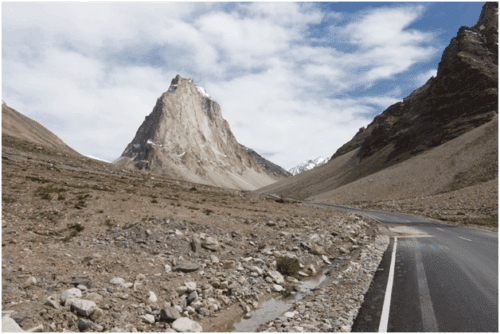
Near Purne rises GomboRangjon (or GonboRangjon), a towering, pyramid-shaped mountain revered by the Zanskari people. Its vertical cliffs shoot skyward, glowing golden at sunset. Pilgrims often walk around its base, treating it as a living deity.
To camp at GomboRangjon is a rare privilege. At night, with the stars wheeling overhead and the mountain looming silently above, you feel its spiritual presence. Riders often describe this as the most mystical moment of the entire Zanskar journey.
The Road to Darcha – Adventure Unleashed
Leaving Padum, the road south towards Darcha is wild, raw, and utterly exhilarating. Built only in recent years, it follows the Tsarap River, clinging to cliffs and plunging through gorges.
Villages like Reru, Purne, Kurgiakh and tiny clusters of houses appear along the way, where locals live a life almost medieval in simplicity—tending to yaks, weaving wool, and farming tiny plots of land carved out of the rocky valley floor. Yaks and dzos (yak-cow hybrids) graze freely, often blocking the trail, a reminder that here, man and nature live in balance.
The road itself is more track than highway—river crossings, loose gravel, landslide-prone cliffs. It is demanding, but this is what makes the ride so intoxicating.
Shinkoo La – The Pass That Opened Zanskar
For centuries, Zanskar was a world unto itself. Locked in by towering mountains on all sides, it remained cut off from the outside world for nearly eight months every year. Once the snow fell in late autumn, there was no way in or out—villagers survived the long winters in complete isolation, relying on stored food, yak butter, and firewood.
The only winter “connection” was the legendary Chadar Trek—a frozen journey on the icy Zanskar River, where locals and traders would walk for days across slippery sheets of ice to reach Leh. For the rest of the year, access was equally daunting—travelers had to trek for weeks over high passes or take the rugged Kargil–Padum road across Pensi La.
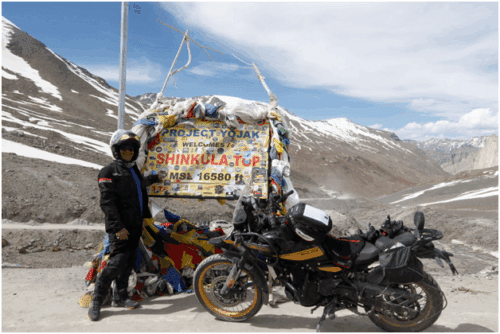
All of this changed with the opening of the Shinkoo La Pass (5,091m) road.
Located at the southern edge of Zanskar, Shinkoo La connects Padum with Darcha in Himachal Pradesh’s Lahaul Valley. It is one of the newest motorable links in the Indian Himalayas, built only in recent years. For the first time in history, riders and locals alike could cross directly between Himachal and Zanskar on wheels, without weeks of trekking or detours.
Riding up to Shinkoo La, you sense this historic shift. The track winds through wild gorges and narrow valleys, climbing relentlessly until suddenly you find yourself on a windswept saddle at over 5,000 meters. Prayer flags snap violently in the thin air. The horizon is a sea of jagged peaks, many unclimbed, stretching endlessly in shades of black, white, and blue.
The feeling at the top is indescribable. You are standing on a road that has, in many ways, broken Zanskar’s isolation. For riders, it’s a triumph of adventure—one of the most thrilling passes you can conquer in the Himalayas. For the Zanskari people, it’s a bridge to the outside world: to medicine, trade, and education that were once a winter’s dream.
Yet, Shinkoo La still retains its raw, untamed character. Snow patches linger even in July. River crossings near its base often flood by afternoon. The road itself is little more than a dirt track, often washed out by landslides and melting snow. Unlike the smooth highways of Ladakh, Shinkoo La feels wild and unpredictable—just as Zanskar itself has always been.
Crossing Shinkoo La, riders don’t just move from Zanskar into Himachal—they ride from a land that was frozen in time into the wider world. It is the symbolic gateway that has transformed Zanskar from an isolated valley to a destination finally within reach, without taking away its wild heart.
To crest Shinkoo La is to touch history—it is the pass that gave Zanskar a road to the world, without stealing away its silence.
Why Zanskar Changes You
Riding through Zanskar is not just about landscapes—it’s about immersion. It’s the way villagers offer you salted butter tea with a smile. The way yaks trudge patiently along cliffside trails. The way prayer flags carry whispered mantras across glaciers and passes.
It’s about silence—true silence—that you feel in Rangdum’s plains, in the shadow of GomboRangjon, and in the cave of Phuktal Monastery.
Zanskar is not just another Himalayan valley. It is one of the last untouched sanctuaries of culture and nature, and to ride through it is to carry a piece of its magic forever.
✨To ride Zanskar is to ride into a living epic—a journey that tests you, humbles you, and transforms you.