Ask a rider in Berlin, a tourer in Texas, or an adventurer in Melbourne what sits at the very top of their bucket list, and the answer is almost always the same. The Indian Himalayas.
It is the “Mount Everest” of motorcycling. It is the place where the map runs out of straight lines.For decades, riders have flown across oceans just to stand next to a milestone that reads 18,380 ft. But those who come here looking only for altitude records often leave with something much deeper. They come for the challenge, but they return for the silence, the ancient rhythm of the Buddhist drums, and the realization that in these mountains, time moves differently.This is not just a ride. It is a pilgrimage.
I. The High Arena: Dancing with the Giants
When you ride the Himalayas, you are riding across the collision zone of tectonic plates. The scale is impossible to capture in a photograph. You are a tiny, vibrating speck of metal and flesh moving through a landscape that feels prehistoric.
The Holy Grail of Altitude
The Indian Himalayas offer the only road network in the world where you can consistently ride above 19,000 feet.
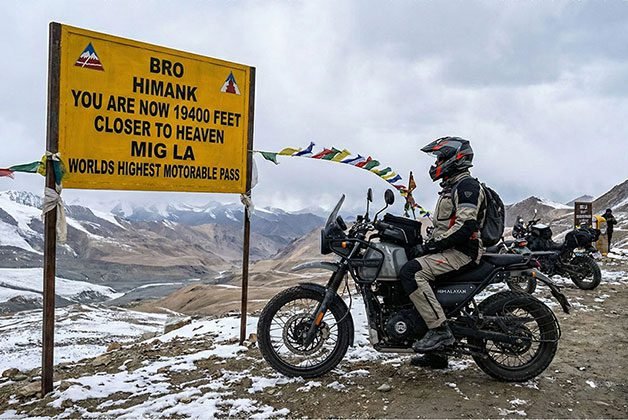
- Mig La (~19,400 ft): The new king. The air here is so thin that engines lose power and riders lose their breath just by walking. It demands a Zen-like focus on the throttle.
- Umling La (~19,024 ft): Higher than Everest Base Camp. The tarmac here is black and perfect, cutting through a barren, wind-swept desert that looks more like Mars than Earth.
But the numbers don’t describe the feeling. It’s the sensation of your helmet tightening as the air pressure changes. It’s the way the sky turns a shade of violent, deep violet-blue that you’ve never seen before because there is simply less atmosphere between you and space.
II. A Living Museum: Monasteries, Monks, and Myths
The Himalayas are not empty. They are alive with a culture that has survived here for a thousand years. As you ride through Ladakh and Spiti, you aren’t just passing scenery; you are riding through a living history book.
The Monasteries (Gompas) You will see them from miles away—whitewashed fortresses clinging to vertical cliffs, their golden roofs blazing in the sun.
- The Sound: When you kill your engine at Key Monastery or Thiksey, the mechanical noise is replaced by the deep, guttural chanting of monks and the clash of cymbals.
- The Smell: The air inside the prayer halls is thick with the scent of yak butter lamps and juniper incense.
- The Sight: Ancient murals (Thangkas) painted in colors derived from crushed stones, depicting demons and deities that protect these valleys.
The People In the villages of Spiti and Ladakh, you meet people who have mastered the art of living in the harshest conditions on Earth. You will see elders spinning hand-held prayer wheels, their faces mapped with deep lines from the high-altitude sun. They wear the Goncha—a thick, voluminous robe of maroon or wool, tied at the waist, designed to withstand the biting winds. Women adorn themselves with perak (headdresses) studded with heavy turquoise and coral stones, passed down through generations. A wave from a local here isn’t casual; it’s a connection. When they say “Julley” (Hello/Goodbye/Thank you), they mean it.
III. The Landscapes: From Moonscapes to Green Valleys
The journey changes every day. The visual drama of the Indian Himalayas is that it never stays the same.
1. The Cold Desert (Ladakh) Vast, brown, and purple mountains that look like molten chocolate frozen in time. The shadows here are long and sharp. You will ride for hours without seeing a tree, only to turn a corner and find a village like Diskit or Turtuk, exploding with green barley fields and apricot orchards, fed by glacial meltwater.
2. The Raw Middle Land (Spiti Valley) Spiti is wilder. The roads here are often carved directly into the rock face. The Kaza-Tandi road is a rite of passage—a mix of gravel, slush, and river crossings that challenge every muscle in your body. It is dust, grit, and glory.
3. The Green Transition (Kashmir & Himachal) And then, there is the change. Crossing Zoji La into Kashmir or descending Rohtang toward Manali, the world softens. The brown gives way to emerald green forests of pine and deodar. The air becomes rich and humid. It feels like returning to life after a journey through the void.
IV. The Human Experience: What Riders Remember
We have led expeditions here for years. We have seen hardened bikers from Europe, tough tourers from the Americas, and seasoned riders from Asia take off their helmets at the top of a pass and simply weep.
It’s not because of the cold. It’s because the Himalayas strip away the noise of modern life.
- It’s sharing a cup of salty Butter Tea in a smoky kitchen with a family that speaks no English, yet understands exactly how cold you are.
- It’s the camaraderie of fixing a puncture at 15,000 feet with a stranger who becomes a brother by the time the wheel is back on.
- It’s the realization that you are small, and that is a liberating feeling.
Ride the Dream
To ride the Indian Himalayas is to join a global brotherhood of riders who have looked at the highest roads on earth and said, “I’m going there.”
Whether you want to conquer the new heights of Mig La, meditate in the silence of Spiti, or navigate the ancient trade routes of Ladakh, we are ready to lead you.
We provide the machines. The mountains provide the magic.
Our Expeditions Include:
- The Machines: High-performance, altitude-tuned adventure motorcycles.
- The Support: Mechanics, oxygen, and backup vehicles that follow every mile.
- The Culture: Stays in heritage properties and authentic homestays, not just hotels.
The mountains are calling. The road is open. Are you coming?